Friday, October 26, 2012

Oran "Juice" Jones - "The Rain"

Here in my area, the last few days have been very rainy. The rain has inspired me to write an entry about the 1986 song "The Rain" by Oran "Juice” Jones.

The RainWhen I listen to music, the aspect of a song that I focus on the most is the sound of the music itself. The song’s lyrical content is secondary to me. I would say it's always been that way. That's probably why, as a child in the 80s, I was drawn to (and greatly enjoyed) the futuristic "electronic" sounds of synthpop music. And then later, in the mid 1990s, I forayed into Rave scene, being attracted to the lyric-less sounds of the electronic music of that subculture.

I think what it all boils down to, regarding the fact that I focus more on the sound of music than on lyrics, is that I have a very good sense of hearing. I even sometimes jokingly tell people that I have “supersonic hearing.” Seriously though, I feel that my sense of hearing is the best of my five senses. And therefore, that’s something that enables to really enjoy the sounds of a song whenever I'm listening to music.

But anyway, needless to say, what I love about this particular song is the way it sounds. And, I’ve always wondered if there’s an instrumental version to this song, as I think it would sound awesome with just the music and no lyrics. The lyrics deal with a man who discovers that his girlfriend is cheating on him with another man. After the halfway point of the song, the singer switches from singing to just spoken words. I’ve always thought that the delivery of the words in that part of the song -- where the man confronts his girlfriend about her cheating -- is pretty silly. It's the only part of the song that I actually dislike. But otherwise, I love the song.

On a side note, the singer, Oran "Juice" Jones, looks like a cross between Eddie Murphy and the actor named Eric Lasalle. :)

Here's the song's video.

Sunday, October 7, 2012

Sophie’s Choice: The greatest performance ever by an actress?

Sophie's Choice movie poster (1982)

If one were to take a poll of “Who do you consider the greatest actress alive?” most respondents would likely choose Meryl Streep. In the same vein, if there is one female acting performance that is generally thought of as the best (or the greatest) of all time, it’s Streep’s performance in the 1982 movie Sophie’s Choice. The role itself is one of Streep’s best-known roles, and I’m sure most people who’ve seen the movie would say that Streep’s performance definitely ranks as one of the best ever by any actor or actress. Streep, being the queen of mastering foreign accents, takes on a Polish accent in this movie. She plays a Holocaust survivor from Poland who lives in a boarding house in Brooklyn, New York with an unstable, abusive boyfriend named Nathan (played by Kevin Kline). The couple befriends a new boarder at the house -- a novelist who’s known as Stingo (played by Peter MacNicol) who hails from the South.

Sophie's Choice houseStreep, Sophie's Choice
Kline, Streep, MacNicol, Sophie's ChoiceKline, Streep, MacNicol, Sophie's Choice

The movie, which takes place two years after the end of World War II, mainly focuses on the friendship of the trio as they go about their day-to-day lives in the boarding house and elsewhere. Sophie had been an inmate of the Auschwitz concentration camp during the war, and while there, she was chosen to work as a secretary for the camp’s Nazi commandant, due to her fluency in German. Once in the United States, and suffering from anemia, she was taken in and looked after by Nathan who works for a pharmaceutical company. As Stingo gets to know this couple better, he comes to discover that there’s more than meets the eye with them. Not only does Sophie have some skeletons in the closet, but it just so happens that Nathan harbors a shocking secret of his own.


The movie itself can be described as lukewarm at best. Directed by Alan J. Pakula, and having a runtime of 2 hours and 30 minutes, it's slow-paced and overlong for its subject matter (it’s primarily a story of friendship). Also, there aren't many scenes showing Sophie’s past, which is somewhat ironic, considering that the title of the movie refers to a choice she made during the war. The actual scene involving the revelation of Sophie’s “choice” is, for the most part, underwhelming.

Meryl Streep, Sophie's ChoiceMeryl Streep, Sophie's Choice

Nonetheless, Streep delivers a spellbinding performance, and she speaks three languages in the movie: English, Polish, and German -- rumor has it that she actually spoke German with a Polish accent. One particular scene, in which she delivers a lengthy monologue, is the best scene of the movie.

This performance remains Streep’s greatest performance ever, and nothing that she's done since has surpassed the caliber of it. Her performance in 1985’s Out of Africa is perhaps the only one that comes close. Streep rightfully won a Best Actress Oscar for her performance in Sophie’s Choice, and it’s bewildering that despite her multiple Oscar nominations since then, the Academy did not give her another Best Actress award until this year (for The Iron Lady, nearly 30 years after her win for Sophie‘s Choice).

When it comes to determining what’s the best performance ever given by an actor or actress, it’s all subjective. I’ve seen lots of films from several decades. To me, Streep’s performance in Sophie’s Choice is, without question, the best performance by any actress during the decade of the 80s. But the best performance ever? Sorry, Meryl, but that is an honor I can only reserve for someone else. As far as I’m concerned, THIS is the greatest female acting performance of all time:


And if you're wondering, the actress is Vanessa Redgrave, and the movie is Isadora (from 1968).

Monday, October 1, 2012

“Fantasy” by Debbie Deb: An example of Miami Freestyle

Fantasy by Debbie Deb

Freestyle is the name of a music genre that was developed during the 80s. New York City is where it originated. Freestyle was essentially a form of dance music, and it was particularly popular among Hispanics. In different parts of the United states, freestyle music branched off into specific regional variants of the genre. One of the most well-known forms of freestyle was the variant born out of the Miami music scene, which of course became known as “Miami Freestyle.” As a Latino growing up in Miami during the 80s, freestyle was one of the main genres of music that I was exposed to in my pre-teen and teen years. A great example of Miami freestyle is the song “Fantasy” by a singer named Debbie Deb, who was one of the quintessential artists of the Miami freestyle scene. The song dates from 1987, and it received a lot of radio airplay that year. Speaking of airplay, I was in 7th grade at the time, and my school bus driver was kind enough to always have the radio playing on the ride home each weekday afternoon -- set to the station that played many freestyle hits. This is one of the songs that I remember sometimes hearing on the bus that year.

Thursday, September 20, 2012

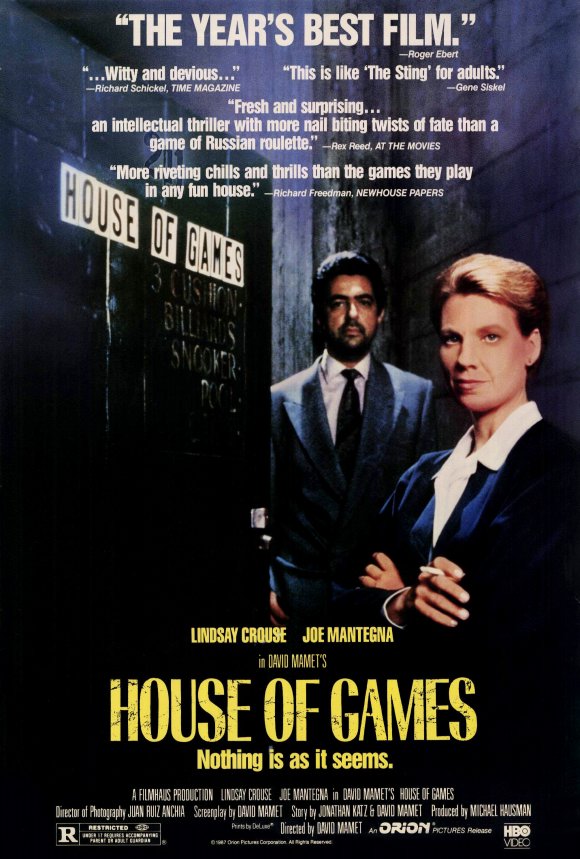
80s neo-noir: House of Games

House of Games movie poster

There seems to be a not-too-uncommon stereotype about psychiatrists and psychologists, which is that more often than not, they turn out to have psychological issues of their own. Or at least that’s what some people believe. And this notion is explored in David Mamet’s 1987 movie House of Games.


Lindsay Crouse plays a psychiatrist (and author of a best-selling book) whose sessions with a compulsive-gambler patient inspire her to conduct research by interacting with some of his gambling associates, in an attempt to help him out. Through her own curiosity, she winds up getting herself drawn into a risky underground world of professional con artists. Her striking sense of adventure seems contrary to her otherwise stoic demeanor. And, as the movie progresses, it becomes apparent that she (despite being a psychiatrist) has some unresolved issues of her own. Certain aspects of her personality begin to unfold as she continues to venture with the grifters. Though, prior to her involvement with them, she had already exhibited a particular peculiarity of making occasional-but-noticeable Freudian slips -- something which later plays a significant role during a pivotal scene in the movie. It’s also worthy of note that she doesn't ever reveal her name to any of the grifters until that very scene. The movie begs two questions: What will result from her interactions with the grifters? And will it lead her to learn more about con-artistry or to learn more about her own self?

House of GamesHouse of Games

During the early and mid 80s, Crouse put in some impressive performances in movies such as Prince of the City, The Verdict, and Places in the Heart (for which she received an Academy Award nomination as Best Supporting Actress). I happen to love the movie Places in the Heart, and I will write a blog entry about it hopefully sometime soon. Despite Crouse’s accomplishments back then, however, she now seems to have fallen off the radar.

House of GamesHouse of Games

The movie also stars Joe Mantegna, JT Walsh, Meshach Taylor, as well as William H. Macy in a small role. In addition, this was the directorial debut for Mamet who was previously a playwright and a screenwriter. For me, the best aspect of the movie is that it has an overall neo-noir feel to it. In particular, some viewers have suggested that this movie’s dialogue (and the delivery of that dialogue) is a sort of homage to film noir of the 40s and 50s. Interestingly, this movie was Roger Ebert’s choice for best movie of 1987.

Here’s the trailer:

Roger Ebert picks House of Games as the best movie of 1987 @6:25


Thursday, September 13, 2012

“Excuse me, are those Bugle Boy jeans that you’re wearing?”

In the late 80s, the Bugle Boy clothing brand released a couple of comical commercials which featured a man clad in Bugle Boy jeans who gets asked by a woman if those are Bugle Boy jeans he’s wearing…and it turns out that that’s all she wants to know from him.

One of the commercials dates from 1989 and features a man in a condominium situated amidst the backdrop of the Miami skyline. He’s sitting in a chair, and he receives a phone call, at which point a woman’s voice on the other end of the line asks if he’s wearing Bugle Boy jeans. When he says yes, she thanks him and hangs up.


Another commercial takes place on a nearly empty desert road. It features the same guy from the previous commercial, standing on the side of the road, seemingly waiting for someone to stop and give him a ride. Suddenly, a black Ferrari speeds right past him, only to quickly stop and go back in reverse to where the man is standing. The driver of the Ferrari turns out to be a woman, who happens to ask him, “Excuse me, are those Bugle Boy jeans that you’re wearing?” He says yes, she thanks him, and then drives off.


By the way, the woman in this commercial is a British former model named Annabel Schofield, who had appeared in Versace ads in 1985.


There’s some debate as to the year in which this latter commercial aired on tv. The person who posted the video of this commercial on Youtube listed the year as 1988. However, someone left a comment on the video‘s page saying that they believe the commercial is from the 1990-1991 period. It’s likely that the commercial was still being aired in 1991. Though I know for certain that it aired in 1990 because I traveled to New York that year and I went shopping for clothes there with a cousin of mine. One of the items I bought was a pair of Bugle Boy jeans, and later that day, my cousin and I were joking about the Bugle Boy commercial, mentioning that “the girl takes off after asking the guy if he’s wearing Bugle Boy jeans.”

One interesting thing about this latter commercial is that it went on to be quite well-known by the public -- it became a meme of the popular culture of the late 80s/early 90s -- and was even parodied various different times, including in a music video by the band Genesis.

Sunday, September 2, 2012

Helen Reddy: From “I Am Woman” to “Imagination”

Helen Reddy Imagination

As a singer, Helen Reddy was quite famous during the 1970s. Her popular song “I Am Woman” was undoubtedly not only one of her biggest hits, but was also considered an anthem of the so-called “feminist movement.”
In the 80s, however, Reddy’s music took a different direction from the Easy Listening tunes she was known for in the 70s. The year 1983 saw the release of Reddy’s album titled “Imagination,” which went on to be the last album she recorded that contained original songs. Among the tracks was “Imagination,” which bears the same title as the album. The song has a strong synthpop-ish sound, very typical of songs from the early-to-mid 80s. The midsection of the song features an instrumental part, which works well with the accompanying video to the song:

I have childhood memories of watching this video on tv after school.

There is also an extended version to the song.


Tuesday, August 21, 2012

Dune: A movie I once disliked but I now love

Dune movie poster

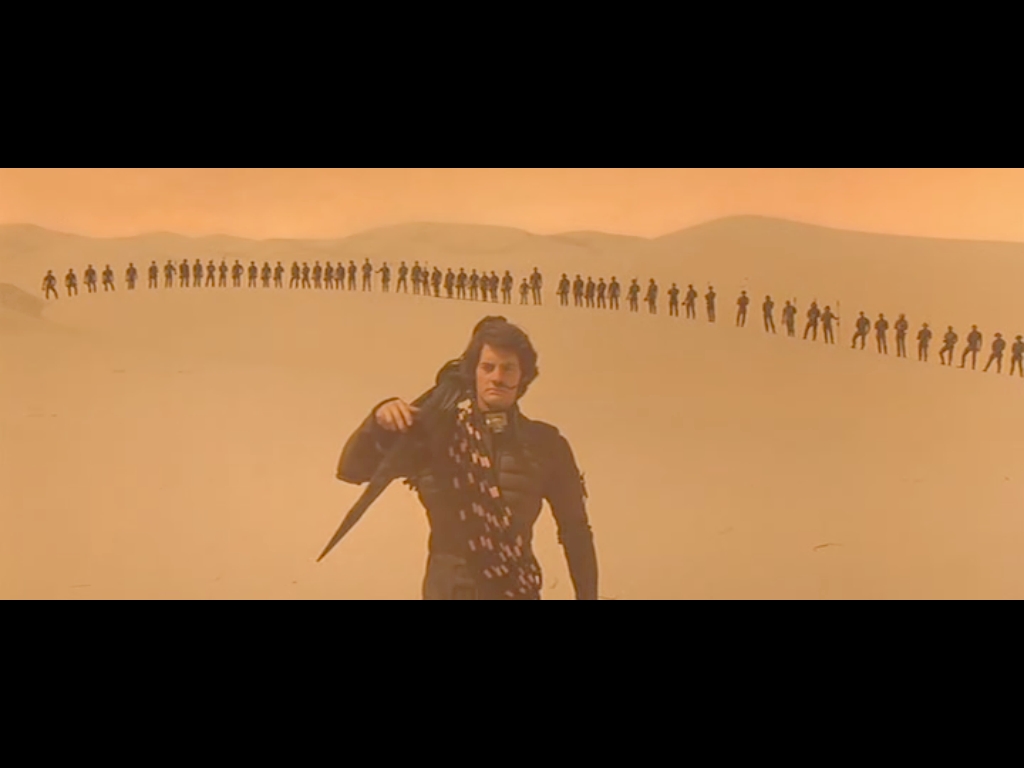
Picture life in the universe in the year 10,191. Such is the basis of the movie Dune, which was adapted from the 1965 novel of the same name, written by Frank Herbert. The story takes place on 4 different planets, and it deals with the harvesting of a so-called spice known as “Melange,” which is used to extend life and to allow an individual to fold space, among other things.

Dune movieDune movie

An interplanetary body known as the Spacing Guild arrives at the determination that there may be an interruption to the harvesting of the spice Melange, and thus sends a representative to investigate the circumstances by speaking with the emperor of the known universe, Shaddam IV. What subsequently ensues involves a feud between warring, rival, noble dynasties for control of the spice harvesting and of the planet where the spice is produced: Arrakis…also known as Dune.


Dune Kyle MacLachlanDune Kyle MacLachlan

The leading character, Paul Atreides, is played by Kyle MacLachlan. And, as it turns out, Paul happens to be a messianic figure of sorts, due to his having been conceived by a “Bene Gesserit” mother -- who, like those of her kind, possesses a particular variety of mind powers which Paul himself has inherited.

Dune movieDune Virginia Madsen

The movie boasts a stellar cast that includes Francesca Annis, Jose Ferrer, Jürgen Prochnow, Sean Young, Patrick Stewart, Max von Sydow, Dean Stockwell, Siân Phillips, Everett McGill, Brad Dourif, and Sting. Virginia Madsen plays the emperor’s daughter Irulan, who also happens to serve as the movie’s narrator.

Dune David LynchDune Alan Smithee

Speaking of the narrator, there are two versions of this movie. One version is known as the “theatrical version,” which is 137 minutes long and features Madsen narrating the opening monologue. The other version is known as the “extended version” or the “tv version”, and it is 176 minutes long. There is a prologue at the beginning of the extended version with an undisclosed male narrator, and it contains paintings which help to set the story up. Also, the extended version lists the director’s name as “Alan Smithee” (rather than the real name of the movie’s director, David Lynch). Supposedly, Lynch did not have a hand in the editing of the extended version and did not want to be associated with it, and therefore the pseudonym “Alan Smithee” was used in place of his own name.

Dune movie poster 1984Dune movie poster 1984
Two additional Dune movie posters

I first saw this movie on cable in the 80s, and I didn't really understand what it was about. In fact, I saw it multiple times back then, and I still didn't understand it. I even found it boring. Now as an adult, the movie makes better sense to me, and thus I have a better appreciation for it. It’s a visually stunning movie, and I really like the whole atmospheric feel that the movie has. It's the type of movie that makes you wanna stay in on a weekend night and watch it in its entirety.

I think a reason why some people don't like this movie is probably because they've only ever seen the extended/tv version and not the theatrical version (which in my opinion is the more coherent version). The extended version is more confusing, and I can understand why people who’ve only seen that version don’t like the movie. But regardless, I can honestly say that I love this movie. It's one of my favorite movies from one of the greatest year for movies: 1984.

Friday, August 3, 2012

My first computer: A Commodore 64

Commodore 64 computer
Image by mwichary licensed under CC BY 2.0

It's funny how now in the 21st century, with all of the modern conveniences that exist, we pretty much take for granted today’s technology. Over the last 15 or so years, the internet has become so ubiquitous and so ingrained in our society that we can’t really picture our lives without it. In fact, internet usage is now a part of many people’s everyday routine. I myself have become reliant on daily internet usage, particularly because of the "at your fingertips" abundance of information that the internet contains -- any topic that you want to look up is just a mouse click away.

Nevertheless, there's just something about the rawness of 80s technology that I happen to miss. The first computer that I ever owned was a Commodore 64. My father bought it for me. The year was 1986. Back then, a Commodore 64 computer was considered state of the art. I remember that the computer had the Basic programming language, and that it required large floppy disks as storage devices. To think of the way technology has changed during the last quarter of a century!

And here's an interesting tidbit about the Commodore 64: it had close to 17 million total unit sales, thus it became the "best-selling single personal computer model of all time" (source: Wikipedia).

Commodore 64 computer screen
Image by regorius licensed under CC BY 2.0

Sunday, July 15, 2012

Matia Bazar - "Aristocratica"

Matia Bazar Aristocratica

Matia Bazar is the name of an Italian synthpop/New Wave band that was founded in 1975. The band was originally fronted by a female singer named Antonella Ruggiero (who remained with the band until 1989). One of the band's most popular hits was a song titled “Aristocratica.”

The song dates from 1984, but I personally first learned of the song in 1987 while watching a tv special on European fashion & culture which aired on the HBO network. A short clip of a video to the song was played during part of the tv special.

Unfortunately, the video clip that I originally saw is not available on Youtube (or anywhere else that I've looked). What I remember from that video clip is that Antonella wore outlandish eye makeup and had her hair teased out -- a look similar to the female image on the cover of the band’s “Aristocratica” album:

Matia Bazar Aristocratica

The geometric green dress on the album's cover was designed by Italian fashion designer Cinzia Ruggeri, and it is known as the “Homage to Lévi Strauss dress”.

Cinzia Ruggeri “Homage to Lévi Strauss dress"

The following video features footage of the band performing “Aristocratica” live, interspersed with pictures of the band.


Thursday, June 28, 2012

Polanski's inner Hitchcock meets Grace Jones

Frantic movie 1988
Polanski during the filming of Frantic
Roman Polanski's films span the gamut of genres: lush epics, engrossing dramas, suspenseful thrillers, clever comedies, and even horror. Despite that, in the decade of the 80s, Polanski directed only two films (or three, if you include his 1979 film Tess, which was released in the United States in 1980 and was nominated for Best Picture at the 1981 Academy Awards). In 1988, Polanski seemed to have channeled his inner Hitchcock by making the suspense movie Frantic.

Frantic movie poster
Set in Paris, the movie deals with a doctor (played by Harrison Ford) who goes on a search for his wife after she mysteriously goes missing from their hotel room. In his quest, the doctor crosses paths with a beautiful young female smuggler (played by Emmanuelle Seigner, Polanski’s wife in real life) whom he was inadvertently led to due to a suitcase mix-up. Eventually, she agrees to help him find his wife. Along the way, he discovers that the reason his wife was kidnapped was that a group of Middle Eastern gangsters were looking for a nuclear detonating device that was hidden in the suitcase that his wife mistook for her own.

Frantic movie 1988


Unlike the director of this film, Harrison had a well-rounded filmography during the 80s, what with his turns as Han Solo and Indiana Jones, as well as the other films he was in.

Frantic movie 1988

One notable detail about this film is that Grace Jones' hit song “I've Seen That Face Before (Libertango)” can be heard playing in the background in a couple of different scenes. Here's a clip of one of those scenes, featuring Ford and Seigner dancing to the song.

Sunday, June 17, 2012

Grace Jones - “I've Seen That Face Before (Libertango)”

In contemporary times, fashion and music have seemed to go hand in hand rather often. Fashion has been influenced by musical styles, and musicians have drawn inspiration from fashion trends. At times, there have even been individuals who found success in both the fashion industry and the music industry, thereby fusing together the worlds of fashion and music. That’s the case with the iconic Grace Jones.

Grace was originally a model. She modeled throughout the 1970s, as well as part of the 80s, working mainly in Paris with top designers such as Azzedine Alaia (to whom she was a muse). She was also a muse to Andy Warhol.

In the late 70s, she landed a record deal with Island Records, and she proceeded to record three albums between 1977 and 1979. In the early 80s, however, Grace entered into a collaboration with stylist Jean-Paul Goude which led to a transformation in her look to a more androgynous style. Coinciding with the burgeoning New Wave style of music, Grace’s own music morphed as well. She released two albums in the early 80s, one of them being 1981’s Nightclubbing.

Grace Jones Nightclubbing

The album contains reworked versions of previously-recorded songs, the most notable of which is “I've Seen That Face Before (Libertango).” The song went on to become one of Grace’s biggest hits. Also, the song was featured prominently in the 1988 film Frantic directed by Roman Polanski.

Grace Jones

Incidentally, the video to the song was directed Jean-Paul Goude, with whom Grace was romantically involved for a time.


There is also an alternate video to the song.

Tuesday, June 12, 2012

Gaultier & Greenaway: The Cook, the Thief, His Wife & Her Lover

Continuing with the theme of Jean-Paul Gaultier...

In addition to Gaultier's fashion design career and his brief foray into music, he has also designed costumes for a number of movies. One of those movies is 1989's The Cook, the Thief, His Wife & Her Lover.

cook thief wife lover
Gaultier costumes

Directed by avant-garde director Peter Greenaway, the movie tells the story of a brutal crime boss who happens to own a restaurant at which he dines every night along with his motley band of henchmen and his lonely, abused wife. The wife, played by the prodigiously talented Helen Mirren, eventually finds herself drawn into a risky love affair with bookish man who also dines at the restaurant on a nightly basis. As the nights go by, the two lovers carry out their affair in the various nooks and crannies of the restaurant, all under the nose of the woman's unsuspecting husband. Inevitably though, the actions of the lovers lead to devastating consequences.

Overall, the movie is graphic and even disturbing, as it contains a couple of scenes that are gruesome. In spite of that though, the movie features striking cinematography and eye-catching set design, and an intriguing use of specific colors in the different sections of the restaurant.

Set Design

Some of the costumes include one of Gaultier’s unmistakable trademarks:
a corset. Here are some examples of his work for the film.

JPG1JPG2
JPG3JPG4
JPG5

Originally, the movie did not get approved for an R rating. According to Wikipedia:
"Due to the content, the MPAA gave Miramax a choice of either an X rating or go unrated (adults only) for theatrical release. Unrated was chosen in light of the X rating being more associated with pornographic films."
Today, the movie has a rating of NC-17.

And finally, from what I've read elsewhere, certain elements of the movie represent an allegory for Britain during the Thatcher years. With such an unconventional movie, who’d have thought? :)